
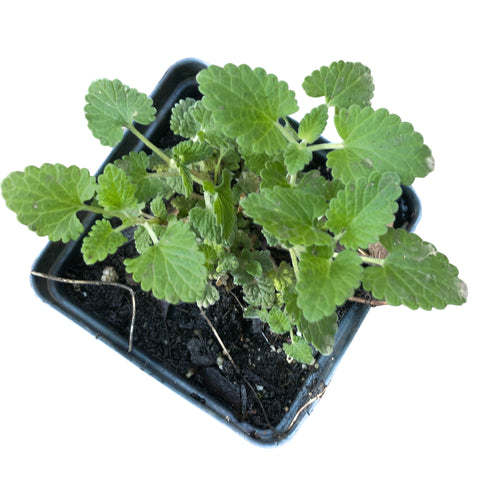
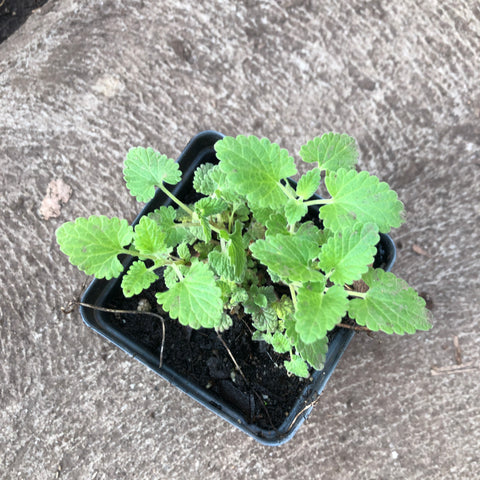



Catnip (Nepeta cataria) Organic Plant in 2.5-inch Pot
You will receive one organic catnip (Nepeta cataria) plant in a 2.5-inch pot. Many cat owners are familiar with this herb, as it can induce short bursts of hyperactivity or a dreamy trance-like state in their feline friends. However, cats are not the only ones who enjoy this plant, as catnip can be used to make a tea and as a culinary herb. Prefers full sun to part shade and well-drained soil. Vigorous, so may perform best in a container in smaller gardens. Zones 3-9.
Catnip (Nepeta cataria L.) is an erect, aromatic herbaceous perennial in the mint family (Lamiaceae), native to southern and eastern Europe, the Middle East, and Central/temperate Asia and widely naturalized across North America and other temperate regions. Known across Smoke Camp Crafts listings such as Catnip (Nepeta cataria) Organic Plant in 2.5-inch Pot (and related to Rattlesnake Master (Eryngium yuccifolium) Organic Plant in 2.5-inch Pot by Smoke Camp Crafts - North American Native Pollinator Plant), the species combines classic Lamiaceae morphology with distinctive iridoid monoterpene chemistry—most notably nepetalactone.
Botanical Morphology & Ecology
-
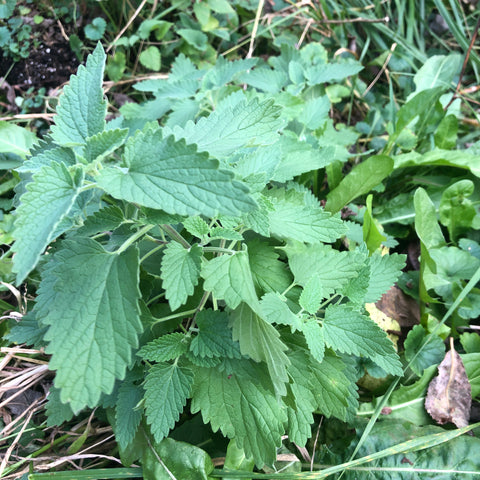
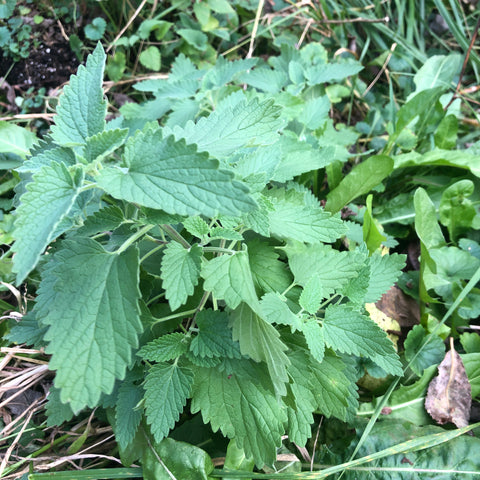
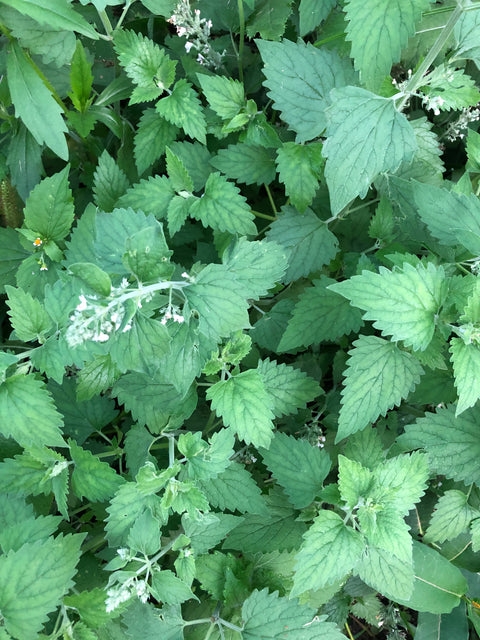
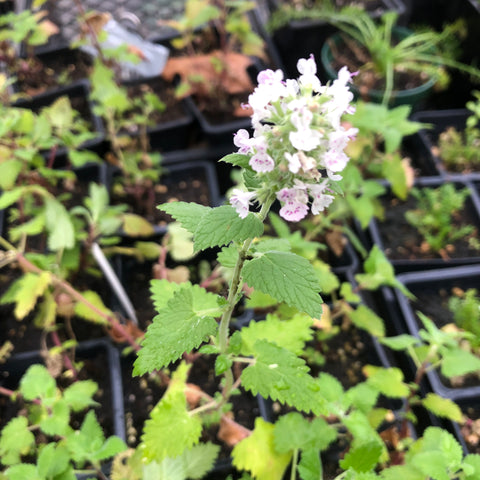
Habit & Stems: Typically grows 30–100 cm (12–39 in) tall from a fibrous root system or taproot, forming branched, mounding clumps with square stems characteristic of Lamiaceae that are covered in fine pubescence and often appear grayish or greenish.
-
Leaves: Opposite, petiolate leaves are ovate to cordate (heart-shaped), roughly 3–7 cm (up to ~3 in) long, with coarsely crenate/serrated margins and a soft, downy/canescent indumentum—especially dense on the abaxial (underside) surface—giving the foliage a muted gray-green cast and releasing a pungent minty aroma when crushed.
-
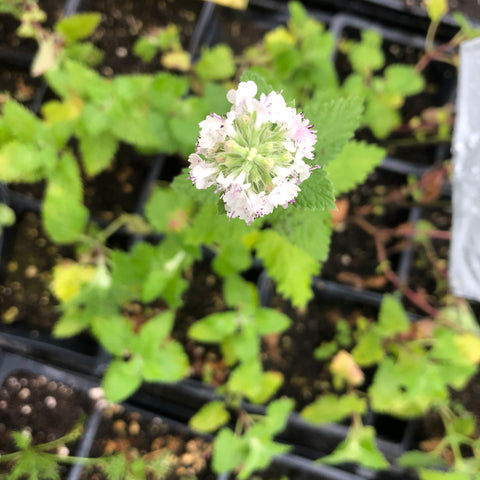
Inflorescence & Floral Structure: Small bilabiate (two-lipped) flowers—commonly white to pale lavender with purple or crimson spotting on the lower lip—are arranged in dense, spike-like whorls (verticillasters) along upper stems from late spring or early summer into autumn. Each flower features a five-toothed tubular calyx, a bilabiate corolla tube with a three-cleft lower lip, four didynamous stamens (two longer, two shorter), and a superior ovary with a bifid stigma.
-
Fruit & Ecology: Develops into a schizocarp splitting into four smooth, ovoid to triquetrous nutlets (roughly 1.7–3 mm long) that readily self-seed. In naturalized ranges, it colonizes roadsides, field margins, open woodlands, and disturbed soils with good drainage, thriving in full sun to partial shade.
Historical & Ethnobotanical Notes
-
Etymology & Classical Roots: The genus name Nepeta traces to ancient Latin nomenclature for aromatic plants and is traditionally linked to Nepete (modern Nepi), an Etruscan town north of Rome, while the specific epithet cataria reflects its long-recognized affinity for cats.
-
Traditional Herbalism & Cross-Cultural Adoption: Across European folk and 19th-century herbal traditions—including American physiomedical practice—Nepeta cataria was prepared as infusions, teas, tinctures, and poultices for digestive complaints (such as colic, gas, and upset stomach), fevers, colds, and mild nervous tension. After its introduction to North America, it was also documented in Native American ethnobotanical records across multiple Nations (including Cherokee, Chippewa, Delaware, Iroquois, Menominee, Mohegan, and Ojibwa traditions) as a medicinal and beverage plant.
-
Historical Crop & Pest Lore: Historically, growers planted catnip along field borders and near grain storage to deter pests such as rats and certain garden insects, and modern chemical ecology has linked its volatile iridoids—particularly nepetalactone—both to feline behavioral responses and to arthropod-repellent and insect-attracting interactions.
Sources
-
North Carolina State University Extension — Nepeta cataria (Catmint, Catnip, Catswort): NC State Extension Gardener Plant Toolbox
-
Reese, R. N. (South Dakota State University) — Lamiaceae: Nepeta cataria: Open PRAIRIE
-
Missouri Botanical Garden — Nepeta cataria: Plant Finder
-
Southern Cross University — Nepeta cataria Medicinal Plant Monograph: SCU Analytical Research Laboratory
-
Gomes, E. N., et al. (2020) — Ethnobotany, Chemistry, and Pharmacology of African Nepeta Species, in African Natural Plant Products, Vol. III: ACS Publications
-
University of Michigan–Dearborn / BRIT — Nepeta cataria L.: Native American Ethnobotany Database