

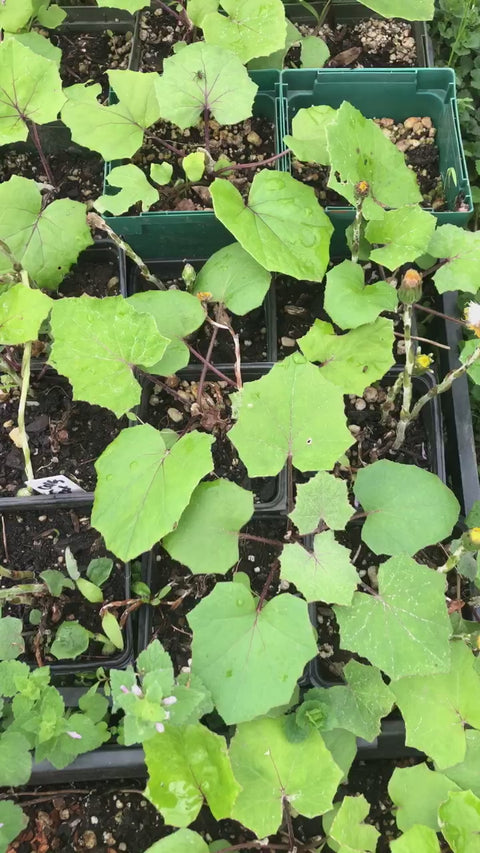


Coltsfoot (Tussilago farfara) Organic Plant in 2.5-inch pot
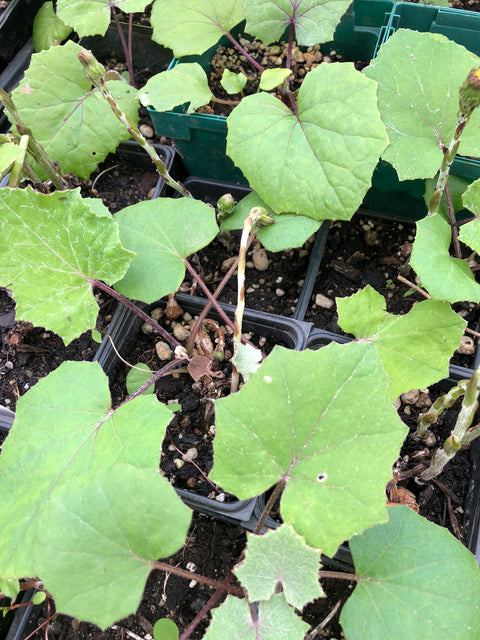
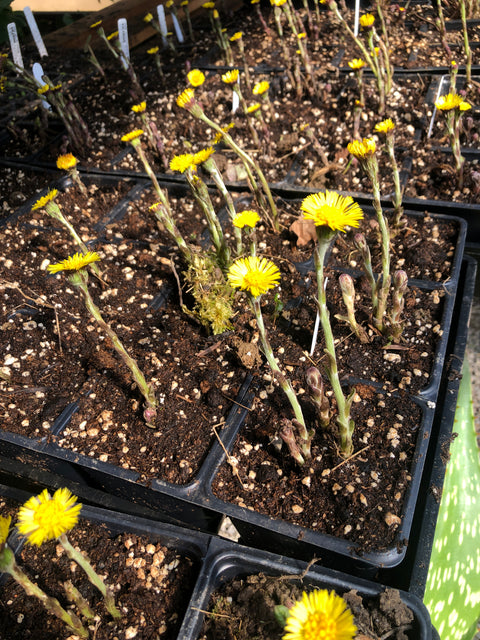
You will receive one organic Coltsfoot (Tussilago farfara) plant in a 2.5-inch pot. Coltsfoot is an early-blooming spring perennial with a yellow daisy-like flower which appears before its large leaves. It thrives in moist shady areas and spreads to form large colonies. Hardy in zones 3-7. Plants shipped in early spring may appear dormant.
Coltsfoot (Tussilago farfara L.) is a low-growing, rhizomatous herbaceous perennial in the aster/daisy family (Asteraceae), and the sole accepted species in the genus Tussilago. Native across Eurasia (from Europe and North Africa through western and central Asia to East Asia) and widely naturalized in temperate North America, it is a classic early-spring pioneer of moist clays, banks, and disturbed ground—currently listed in the active catalog on Smoke Camp Crafts as Coltsfoot (Tussilago farfara) Organic Plant in 2.5-inch pot (SKU: PLANT_COLTSFOOT).
Botanical Morphology & Ecology
-
Phenology & Habit: Tussilago farfara exhibits a striking temporal separation between reproduction and foliage: solitary, dandelion-like yellow capitula (flower heads) emerge in early spring on leafless, erect scapes (roughly 5–25 cm tall) clothed in scale-like, purplish-red or brownish bracts, while the basal foliage unfolds only after flowering begins. It spreads vegetatively via creeping underground rhizomes, often forming dense clonal patches.
-
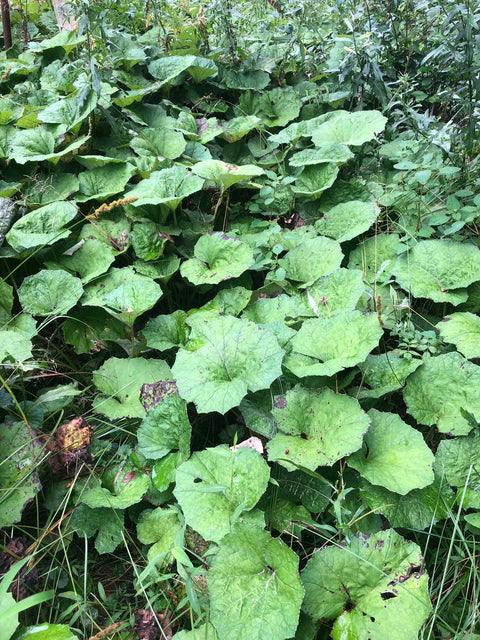
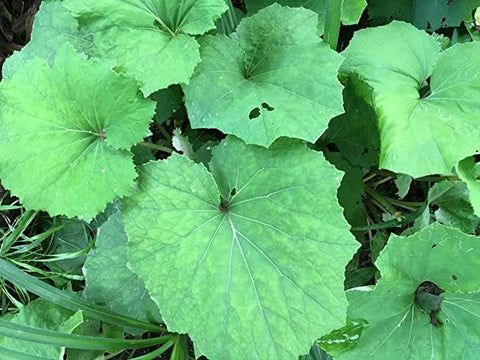
Leaves: Basal leaves arise directly from the rhizome on long petioles and expand into broad, cordate to rounded/hoof-shaped blades with angulate or toothed margins and palmate/radial venation. The adaxial (upper) surface becomes relatively smooth and green at maturity, whereas the abaxial (underside) surface is densely covered in white-woolly tomentum.
-
Inflorescence & Fruit: Each terminal flower head consists of numerous slender outer ray florets (pistillate) and central disc florets (functionally staminate) in bright yellow, opening in sunlight and closing in dull weather or at night. Fruits are small achenes bearing a fine pappus that disperse on the wind.
-
Ecology & Cultivation Notes: Thriving as a pioneer on moist, heavy clay, banks, and disturbed soils across a broad pH range (5.0–8.0) and hardy in USDA Zones 3–7, its aggressive rhizomatous spread means it is best planted where spreading is desired or contained. Botanically and pharmacognostically, field workers note the need to distinguish Tussilago farfara from superficially similar taxa such as butterbur (Petasites spp.), and modern phytochemistry highlights both mucilage/phenolics/sesquiterpenes and pyrrolizidine alkaloids (hepatotoxic compounds present in varying concentrations that have prompted regulatory cautions on internal herbal use).
Historical & Ethnobotanical Notes
-
Etymology & "Son Before the Father": The generic name Tussilago derives from Latin tussis ("cough") and agere ("to drive away"), reflecting its ancient reputation as a cough remedy, while farfara echoes old Latin naming (and pharpharia noted in classical tradition). Because its flowers appear ahead of its leaves, medieval and early modern herbal lore famously nicknamed it filius ante patrem ("the son before the father")—a quirk that also helps explain why Pliny the Elder's Naturalis Historia included contradictory remarks about its stems, blossoms, and seeds.
-
Classical & Cross-Cultural Medicine: In Greco-Roman and Islamic medical traditions—appearing in works associated with Dioscorides, Pliny, Galen, and Avicenna (The Canon of Medicine)—coltsfoot leaves, flowers, and fumes/infusions were widely used for coughs, hoarseness, and respiratory complaints, while its presence in damp ground was also noted by observers looking for water or springs. Parallel traditions in East Asian medicine have likewise long employed Tussilago farfara flower buds (Flos Farfarae) in multi-herb respiratory formulations.
-
English Vernacular & Pioneer Role: The English name "coltsfoot" (alongside historical variants like foal's foot and coughwort) arose from the hoof-like outline of the leaf. Beyond traditional herbalism, its ability to colonize raw clay, embankments, and post-disturbance ground has long made it an unmistakable marker of early-season spring activity and pioneer soil stabilization.
Sources
-
Chen, H., et al. (2020) — A review of the ethnobotanical value, phytochemistry, pharmacology, toxicity and quality control of Tussilago farfara L. (coltsfoot), Journal of Ethnopharmacology: PubMed Central (PMC7561605)
-
Tobyn, G., Denham, A., & Whitelegg, M. (2016) — Tussilago farfara, coltsfoot, in The Western Herbal Tradition: ResearchGate
-
Modern review on Tussilago farfara L. (Asteraceae) ethnobotany, phytochemistry & biological activities: ResearchGate
-
Coltsfoot: History and Traditional Use (historical nomenclature, Pliny, Dioscorides, Grieve, Culpeper & Petasites comparison): MyHealthCare
-
Grow Coltsfoot: Care, Harvest & Companion Plants (Tussilago farfara growth habit, soil tolerance & pyrrolizidine alkaloid notes): PlotMyGarden